Showing posts with label muwaḥḥad. Show all posts

Sunday, 16 March 2025

The Moroccan Qurʾān / Le Coran maroccain (Anouk Cohen)

For the last fifteen years, Anouk Cohen writes the same article again and again.
There is nothing wrong, with having found one's field.
Everything is wrong when one finds the same mistakes from the first article to the last.
In my view, the last one (Seeing and Hearing the Book: A Moroccan Edition of the Qurʾan) is just a string of errors, not worth listing them.
In it she compares "the Saudi edition" with "the Moroccan Qur'an" aka "the muṣḥaf muḥam­madī" although there are more than a hundred Saudi editions, more than hundred Moroccan Qur'an editions and three very dif­ferent "Muṣḥaf Muḥam­madī" (about ten with minor dif­ferences).
The "differences between THE Saudi and THE Morroccan" do not exist:
Moroccan editions are the trans­mission of Warš following Nafīʿ, with saǧadā signs accord­ing to the Malikī maḏhab, Madinī verse counting, Maġribī hand­writ­ing/font.
What Cohen shows as THE Saudi edition is the trans­mission of Ḥafṣ following ʿĀṣim, with saġadā signs according to the Hambalī maḏhab, Kūfī counting, nasḫī handwriting/font by ʿUṯmān Ṭaha, printed by KFC.
But there are Moroccan reprints of Saudi editions ...
... and the Suʿudī "King Fahd Glorious Quran Printing Complex" (KFC) publishes the Warš transmission in Maġribī hand­writing.
Suʿudī is not always the same. The KFC publishes editions for North-West Africa and for India (but not for Turkey, Iran, nor Indo­nesia).
Here images that show that there is no clear cit between muṣḥaf muḥam­madī"-Malikī and the rest-non-Maliki
According to Cohen this is THE muṣḥaf muḥam­madī fatiḥa:
But this is a muṣḥaf muḥammadī fatiḥa as well:
According to Cohen this is THE Saudi one
But these are two more (out of many) from Madina
To put it bluntly. What Cohen writes is based on 90% ignorance resp. blindness.
p.142: "According to the protocol defined in the 1920s in Cairo by al-Azhar each stage of pro­uction should be sub­ject to control."
    ‒ no source given, de­finetly wrong
p.144: "the Egyptian copy [of the Qurʾān] developed at al-Azhar in 1924
    ‒ just wrong
p.144: "Contrary to the muṣḥaf ḥassanī, which was to be offered to dis­tin­guished guests, the muṣ­ḥaf muḥam­madī was placed under serial and industri­al pro­duction."
    ‒ wrong, both maṣā­ḥif have expen­si­ve (big, colour, glossy paper) versions and cheaper ones, and none is gift only: one could buy them.

Before I move on to the Warš muṣḥaf of 1929: A.Cohen writes three pp. 145-148 on the calli­graphy of the "Mo­roc­can muṣ­ḥaf" incl. strange things like "'The line should not be so long, even if it does not change the meaning. There should be no ex­cessive read­ing.'” quoting a "cleric".
‒ first, the cleric says: "There should be no ex­ten­ded line because that could lead to pro­longa­tion in recit­ing."
‒ second, "of course" there are extended lines in Maġ­ri­bī maṣāḥif to justify lines. The first word /ḏālika/ is from Cohen's text, showing what is forbidden. All others are from Muṣḥaf al-Ḥasanī.

Three pages, but she does not mention THE most important fact: Muṣḥaf Muḥammadī is not handwritten by PC set!


Let's move to what she calls "the 'Qurʾan of Zwiten,'26 26 ... Until recent­ly, the rights to it be­longed to Dar al-muṣḥaf al-sharīf, in Cairo. See Abdul­razak Fawzi, The King­dom of the Book: The History of Printing as an Agency of Change in Morocco bet­ween 1865 and 1912 (PhD diss., Uni­ver­sity of Boston, 1990)."
Of course A. Fawzi says no­thing of the kind. Why else do we not get a page number, where he would say so? A.Cohen is making it up as in most of her publi­cations: Hot air or lies!
Of course we do not get any infor­ma­tion about this print of re­ference, not even a picture of the cover, nor of any of the pages! ‒ just as in her ear­lier articles she wrote that it was very often re­printed without giving years, nor pub­lishers!
As often, Bergsträßer tells us a lot

He quotes the "Maghribian book sellers" (two members of the al-Ḥabbābī familiy) that Egyptian printers and Šaiḫs could improve the edition, written by Aḥmad bn Ḥasan Zwīten, checked by Moroccan šaiḫs, and again in Egypt, where it was printed ‒ dedicated to Sulṭan Muḥmmad [V.] bn Yūsuf
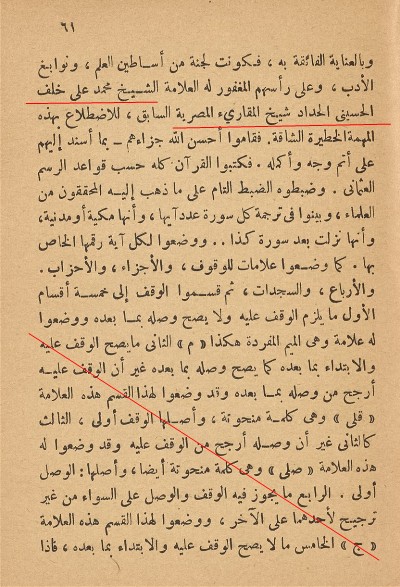
This Cairo Warš Edition, Cairo 1929 Edition, al-Ḥabbābī edition, Zwīten edition is the first Moroccan edition with numbers after each verse, and ‒ a revolution of sorts ‒ Kufī numbers;
so ʿAlī Muḥammad aḍ-Ḍabbāʿ (1304/1886-1380/1960) writes four pages on the differences between (second) Madani and Kufi mumbering (pages 8-11):
the cover of the first edition
the first three pages:
instead of a title page:
(this is from the copy of the Academy of Sciences in Lissa­bon that is not paginated in quarters, but in halves; its index and the duʿāʾ are set in normal Arabic letters, while hand­written in the original.)
the ʿanwān of the first edition
So are no pagination.
As often, THE Zwīten does not exist, the original one is divided into four parts, and has before the quranic text faḍl al-qurʾān and ādāb at-tilāwa; all is hand­written, the last four pages in eastern nasḫ pointed like in the east (no dots on final nūn, fā' and qāf, fā'-dot below, single qāf-dot above), all other parts in maġribi masbūṭ, while the Lissa­bon copy (in halves) lacks most additions.
Maybe these two strange pages are due to merging quarters into halves (??) Or to have the ḥizb start on a new page?
Normal pages have 15 lines
last page of first half
With a book seller I found a last quarter printed in 1990.


She does not know that most Western readers need the number of suras.
"al-Naml (the Ants)" should be "XXVII" or "an-Naml (27)".
ḫaṭṭ is handwriting, script, not calligraphy which is fann al-ḫaṭṭ.
taḏhīb is gilding, not illuminations.
taškīl is vocalization, not "vocalization signs"; vowel signs are harakāt.
the commander of the believers, not commanders of believers:
Why does she call his function "myth"?
She translates her French "encore" (in Voir et entendre le Livre. Une édition maro­caine du Coran. 2017) (which means here « en outre »/"fur­ther­more, more­over") as "still"/ « tou­jours » « quand même » .

The article feels like written by a large language model artifi­cial intel­ligence.
Some sentences sound reasonable, others like halu­cina­tions

Sometimes the connection is missing: first [he writes] "on paper plates",
which are then "calligraphic tablets".
lawḥ, a wooden tablet, is defined as "a Qurʾanic tablet that com­bines writ­ing and recita­tion"
‒ it has no loud speakers.
First she writes ‒ correctly ‒ of "the seven canonical readings (qirāʾa)",
then ‒ in­correct­ly ‒ of "the seven Moroccan reci­tations";
the seven qirāʾāt (proper plural form) neither being Moroccan, nor reci­tations.
similarly: "the dominant recitation in Morocco (Warsh)" ‒ the ways of recitation (taḥzzabt, muǧawwd, murattal) have nothing special to do with Warš ‒ no more than "high way" with Chrys­ler and Tesla.
her note 2: muṣḥaf = volume, Qurʾān = revelation, while the first is "codex", the second "reading, reci­tation"
In note 20 she cites Gérard Trou­peau with: "To indicate the three short vowels, [Arabic] borrowed three Syriac signs" although Trou­peau has not written this, and it is cer­tainly wrong.

The most common edition is in the "Unified Maghribi script" al-ḫaṭṭ maġribī at-tūnisī al-ǧazāʾirī al-ifrīqī al-muwaḥḥad
‒ ­

Saturday, 6 November 2021

"the Cairo Edition"

Ik bedoel: jij, als beste Quranoloog, moet vermijden wat er met Gotthelf, Otto, Theo en Pim is gebeurd."
Als het op transcriberen aankomt, ben je erg precies. Als het gaat om edities, drukken, versies, recensies, ben je slordig.
editie betekent = "bepaalde druk van een ... boek"
uitgave, exemplaren die in één keer gedrukt worden, druk van een boek
1) Aantal gedrukte exemplaren 2) Aantal te drukken exemplaren 3) Aflevering 4) Boek­uitgave 5) Deel van een krantenoplage 6) Druk 7) Druk van een boek 8) Oplaag 9) Oplaag van een boek 10) Oplage 11) Oplage van boeken
Dat is iets anders dan een teksteditie of tekstuitgave.
edition = The entire number of copies of a publication issued at one time or from a single set of type. / The entire number of like or identical items issued or pro­duced as a set
Édition (Nom commun)
[e.di.sjɔ̃] / Féminin
Impression, publication et diffusion d’une œuvre artistique (livre, musique, objet d’art, etc). soit qu’elle paraisse pour la première fois, soit qu’elle ait déjà été imprimé ; ou les séries successives des exemplaires qu’on imprime pour cette publication.
Totalité des exemplaires de tel ou tel ouvrage publié et mis en vente.
Par extension, l’industrie qui a pour objet la publication d’ouvrage.
Tirage spécifique de la même édition d’un ouvrage.
Exemplaire faisant partie d’un tirage dans une édition.
(Journalisme) Tirage strictement identique de l’édition du jour d’un quotidien.

In het Frans is het bijzonder duidelijk: « maison d'édition » betekent een uitgeverij.
"editie" is niet wat een editor/een redacteur doet, maar wat an publisher/een uitgever doet.
Als je naar klassieke Arabische werken kijkt, waren er tot voor kort mees­tal twee of drie edities: één uit Leiden en één uit Cairo, één uit Göttingen en één uit Oxford. Hier, "the Cairo edition" maakt geen probleem.
Maar met de Koran is het anders: er zijn tegen­woordig duizenden edities. Alleen al uit Cairo zijn er tien belangrijke uitgaven van de Warš lezing.
it was printed in Qāhira by Muḥammad ʿAbdalraḥmān in 1383/1964 (maybe second and third part ayear later).
it is definitely a "Cairo Edition" although often reprinted in the Maġrib.

Here two images from a 1929 Cairo Warš Edition ‒ without a title page, as was common at the time:
And here from two of the oldest al-Qahira pub­lishers, i.e. not from Bab al-Khalq, al-Faggala, from Bulaq or even Giza but from "behind" al-Azhar:
Apart from these 100% Cairo Editions, there are editions con­ceaved in Morocco resp. Algeria, but pro­duced in Cairo ‒ the Moroccan ones without pro­duction place, the Algerian ones with an Algerian publisher's name. (Only the third edition of the third sherifian muṣ­ḥaf was produced in Morocco.)
Er is niet meer "de editie van Caïro" dan er "de Ayatollah" of "de roman van Parijs" is.
Alleen drukwerkspecialisten zijn geïnteresseerd in drukwerk (hoeveel regels per pagina, hoeveel pagina's per ǧuz, aanduiding van chronologie, saǧadat, sakatāt, typografie, kalli­grafie...). Curana­loogen zijn geïnteres­seerd in het rasm, de lezingen en de orthografi.
Zelfs als we alleen kijken naar de belangrijk­ste Ḥafṣ uit­gaven, zijn er enkele uit 1881, 1890, 1924, 1952, 1975, 1976. Zelfs de uitgaven van de Amīriyya uit 1926 en 1929 ver­schillen van de Gizeh-druk uit 1924.
Ik weet niet welke editie bedoeld wordt ‒ zou kunnen bedoeld worden ‒ met "cairo edition".
Ik heb de indruk dat u de Uthman rasm bedoelt, het gebruike­lijke schrift zonder extra alifen, dat gebruike­lijk werd in het Otto­maanse Rijk en Iran.
De druk van Gizeh uit 1924 is bijna nergens in de islami­tische wereld te vinden, maar vaak wel in Duitse, Neder­landse en Zwit­serse biblio­theken.
80% van de Moslims gebruiken totaal ver­schillende uit­gaven, zij het ver­schillende lezingen, zij het ver­schillende spellingen. Tot in de jaren tachtig gebruikten de Arabers van Mašriq ook overwegend Otto­aanse edities.
Tegenwoordig gebruiken veel Arabieren, Maleisi­ërs en Sala­fisten edities in de spelling van de 1952 editie van de Koran, maar alleen Oriënta­listen hebben ooit de Amīriyya editie gebruikt.
Een derde van de moslims is af­komstig van het Indiase sub­continent, zodat Indiase kwesties wereldwijd het meest voorkomen.
Bijna een zesde van de moslims gebruikt Indo­ne­sische edities.
Turkije heeft zijn eigen standaard, Iran heeft er meerdere.
Der Ausdruck ‚die Kairoer Ausgabe‘ oder ‚die Cairo edition‘ ist nicht nur ungenau, sondern schlicht falsch. Er setzt voraus, dass es eine einzige, klar identifizierbare ‚Edition von Kairo‘ gibt. Tatsächlich gibt es Hunderte, wenn nicht Tausende, in Kairo gedruckte Koranausgaben, die sich in rasm, Lesung, Orthographie und typographischer Tradition unterscheiden. Der bestimmte Artikel im Singular ist hier logisch unzulässig.
The expression ‘the Cairo edition’ is not merely imprecise, it is simply wrong. It presupposes that there is a single, clearly identifiable ‘edition from Cairo’. In reality, there are hundreds, if not thousands, of Qurʾān printings produced in Cairo, differing in rasm, qirāʾa, orthography, and typographical tradition. The definite singular article is logically impossible in such a situation.
De uitdrukking ‘de editie van Caïro’ is niet alleen onnauwkeurig, maar gewoon onjuist. Ze suggereert dat er één, duidelijk identificeerbare ‘editie uit Caïro’ bestaat. In werkelijkheid zijn er honderden, zo niet duizenden, in Caïro gedrukte koranuitgaven, die van elkaar verschillen in rasm, lezingen, spelling en typografie. Het gebruik van het bepaald lidwoord in het enkelvoud is hier logisch onmogelijk.

Nairīzī

Mirza Aḥmad an-Nairīzī (ca. 1650–1747) is the last of the classical Iranian calligraher s. Informations are hard to find, because often und...