Showing posts with label Morocco. Show all posts
Thursday, 14 May 2026
Sunday, 23 May 2021
Morocco ... Muṣḥaf al-Muḥammadī
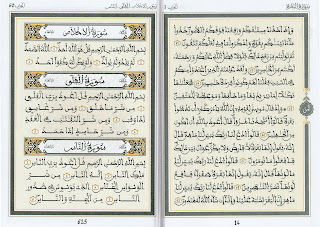
To commemorate Ḥasan II's silver jubilee and later Muḥammads VI's accession to the throne the Kingdom
published editions in maghrebian style ‒ both in colour and black&white.
I looked in vain for information about the printing place.
This could be the reason for the reserve:

The press wasn't in the Sherifian Kingdom, but in Cairo. Al-Muǧallad al-ʿArabi (often printers make up names for special occasions) was in charge.
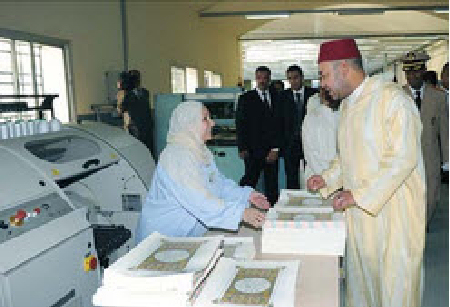
But the third edition was home made ‒ in a press founded in Faḍāla (named Muhammedia since 1959) after WWII and bought in the 1960ies by the Minstery for Religious Affairs and Pious Foundations al-Maṭbaʿ al-Faḍāla.


While under Ḥasan II there was only one Royal Muṣḥaf (in cheap and in expensive editions) ‒ written by seven Moroccan calligraphers
there are new four different ones:
‒ one hand written, similar to his father's
‒ one computer set ‒ "andalusian", i.e. with green dots for hamzat,
‒ one computer set ‒ "moroccan"
and the same in an expensive edition:
and with reduced colours:
‒ one with images of wooden tablets from madrasas‒ printed 2007 in Graz, Austria.
Saturday, 26 September 2020
Morocco before 1924
Bergsträßer saw the similarities between Warš editions and the Gizeh print.
Because he did not question al-Ḥusainī al-Ḥaddād's assertion that "his" edition was a reconstruction based on the oral text and the literature about How to Write a Muṣḥaf, he assumed an immediate influence from Gizeh/Cairo to Fèz/Alger.
For me it was clear that it was the other way around.
But I had no proof.
I did not have an early print from the Maġrib (nor a Warš edition from Cairo from before 1920).
Finally, I can proof it. I have images from Faz prints from 1879,'81,'91, '92,'93,'94, '95,'99, 1900 and 1905.
The two oldes are in big format and still have red dots for hamza:
On the left the (presumably) first print by Ḥaǧǧ aṭ-Ṭaiyib al-Azraq 1879,
on the right the same text from Alger 1350/ 1931 (Maṭbaʿa aṯ-Ṯāʿlibiyya of Rūdūsī Quddūr ben Murād at-Turkī, likely ʿAbdal Qādir from Rhodes)
one from 1881: Later they are without colour and smaller:
Subscribe to:
Posts (Atom)
Dānī or Abū Dāʾūd? Indonesia’s Qurʾān Revisions — and the Trail to Bombay
Even when their wording is identical, (Ḥafṣ) Qurʾān editions do not look the same everywhere. A long ā may be written with an ordinary ...
-
Even when their wording is identical, (Ḥafṣ) Qurʾān editions do not look the same everywhere. A long ā may be written with an ordinary ...
-
40 years ago Adrian Alan Brockett submitted his Ph.D. to the University of St.Andrews: Studies in Two Transmissions of the Qurʾān . Now...
-
Many things experts present as remarkable about the 1924 Egyptian Government print of the Qurʾān, the King Fuʾād Edition, are wrong: it w...