Showing posts with label mistake. Show all posts
Friday, 4 October 2024
one change made
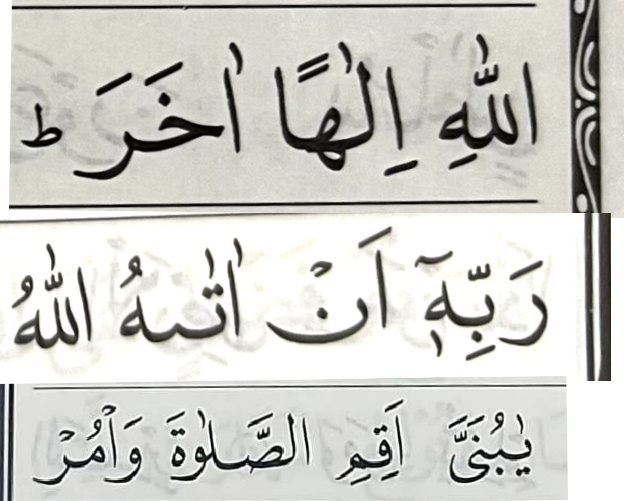
while 2:264 was a mistake made inadvertently in Cairo
on 56:2 Qaṭar made a conscious change
Because 55:2 is written without alif in Al-Mushaf Al-Sharif Attributed to Uthman Bin Affan in the Topkapı Palace published by Tayyar Altıkulaç (İSAM) who adviced the Qaṭāris they followed the old manuscript.
mistake corrected
An inconsistency made in Cairo in 1924 got remedied in Madina.
The typesetter in Būlāq made a mistake in 2:264.
ʿUṯmān Ṭaha copied it faithfully.
It was first corrected in the UT pc set version of the State of Kuwait, printed in Khartum,
later in UT3 of the King Fahd Complex.
The hamza should not sit on the tooth. Oh — actually the other way round. here as most of the time, the maġrīb makes it as it should be.
I want to look at the "problem" in a general way.
In 4:112 we have
with /ī/, while in /riʾāʾ/ there is just a short /i/: after /ī/ the hamza sign hovers over the connection; when there is no /ī/, it sits on the tooth.
Above I mentioned that Otto Pretzl pointed out the inconsistency in writing /riʾāʾ/, but his point was that ad-Dānī has the hamza one the tooth.
And he was concerned by another group of mistakes. ad-Dānī writes the dual without alif, the KFE mostly with alif. the first line is BnF arabe 328a
The typesetter in Būlāq made a mistake in 2:264.
ʿUṯmān Ṭaha copied it faithfully.
It was first corrected in the UT pc set version of the State of Kuwait, printed in Khartum,
later in UT3 of the King Fahd Complex.
The hamza should not sit on the tooth. Oh — actually the other way round. here as most of the time, the maġrīb makes it as it should be.
I want to look at the "problem" in a general way.
In 4:112 we have
with /ī/, while in /riʾāʾ/ there is just a short /i/: after /ī/ the hamza sign hovers over the connection; when there is no /ī/, it sits on the tooth.Above I mentioned that Otto Pretzl pointed out the inconsistency in writing /riʾāʾ/, but his point was that ad-Dānī has the hamza one the tooth.
And he was concerned by another group of mistakes. ad-Dānī writes the dual without alif, the KFE mostly with alif. the first line is BnF arabe 328a
Sunday, 21 July 2024
long-fatha alif OR alif long-fatha [ʾā] OR [āʾ]
In manuscripts and lithographs the turned fatha [ā] sometimes sits instead on or after lām (لـ) or hamza (ا) before lām or hamza.
If it is due to lack of place and occurs seldom, it is not a problem.
But in some modern computer set prints
long fathas are always after lām and always before hamza.
Why?
I assumed that the IT experts first type the long fatha, then the hamza(alif), but because the /ā/ always comes first and then the /ʾ/
I now guess that in the data stream there is no mistake,
but the font is the culprit:
that the font places long fatha that is logically after hamza
graphically before the hamza, because it looks nicer.
Can anyhow tell them that the text is there to be read, not to look nice.
For those who do not understand,
here is the SAME electronic text, rendered by two different fonts:
What is true for /ʾā/ is true for /ʾī/ as well.
Wednesday, 24 November 2021
riʾāʾa ‒ sometimes like this; sometimes like that
Already Otto Pretzl had noticed that in Gizeh1924 riʾāʾa was not written the same at the three places it occurs ‒ without the authorities prescribing that.
Iranians and UT2-KFC have the first hamza always after the tooth.
Muṣḥaf al-Azhar aš-Šarīf (Cairo 1978‒1986?) has it always on the tooth:
The others have it sometimes on, sometimes after the tooth.
In 2:264 it is normally on the tooth, except UT2-KFC and Iran.
In 4:38 it is normally after the tooth, except Taj-KFC ‒ probably changed in the next edition (1440h. it is still on the tooth).
In 8:47 all have it after the tooth except Muṣḥaf al-Azhar aš-Šarīf.
Iranians and UT2-KFC have the first hamza always after the tooth.
Muṣḥaf al-Azhar aš-Šarīf (Cairo 1978‒1986?) has it always on the tooth:
The others have it sometimes on, sometimes after the tooth.
In 2:264 it is normally on the tooth, except UT2-KFC and Iran.
In 4:38 it is normally after the tooth, except Taj-KFC ‒ probably changed in the next edition (1440h. it is still on the tooth).
In 8:47 all have it after the tooth except Muṣḥaf al-Azhar aš-Šarīf.
Thursday, 4 November 2021
Mistake in the Andalusian/Maghribi/Arab Style
One of the errors in the 1924 Qur'an that Indians, Indonesians, Persians and Turks take exception to is that "God" is written with a short a: ʾallah instead of ʾaḷḷāh.
In "Kein Srandard" I call that a clear mistake.
But what is 100% clear?
The Arab advocates of the 1924 reform might say:
Even Ibn al-Bawwāb wrote like this
I reply:
yes, but raḥmān is also with short a and ḏālika too.
If there is no long /ā/ sign in the whole codex,
then you don't need one in ʾaḷḷāh.
But in the Giza Qur'an there is Long-ā (fatḥa + dagger-alif) everywhere where needed!
As explained in "Kein Standard" Bergsträßer and experts have overlooked that
the 1924 orthography is not an invention, but just copied from a Warš muṣḥaf:
And just as these do not spell ʾaḷḷāh correctly
but incorrectly,
so does G24 and since 1990 all Arabs (esp. Madina).
At least, they write ʾallah all the time:
instead of ʾaḷḷāh:
the Nizām of Hyderabad had it corrected (1938, reprinted by the Islamic Call Society 1976f.):
but not in allahumma (nowhere, and in none of the bilingual editions ‒ cf. first line)
Two examples from Dalīl al-Ḫairāt, one from Mali without long /ā/, one from the Ottoman Empire with long /ā/:
I reply:
yes, but raḥmān is also with short a and ḏālika too.
If there is no long /ā/ sign in the whole codex,
then you don't need one in ʾaḷḷāh.
But in the Giza Qur'an there is Long-ā (fatḥa + dagger-alif) everywhere where needed!
As explained in "Kein Standard" Bergsträßer and experts have overlooked that
the 1924 orthography is not an invention, but just copied from a Warš muṣḥaf:
And just as these do not spell ʾaḷḷāh correctly
but incorrectly,
so does G24 and since 1990 all Arabs (esp. Madina).
At least, they write ʾallah all the time:
instead of ʾaḷḷāh:
the Nizām of Hyderabad had it corrected (1938, reprinted by the Islamic Call Society 1976f.):
but not in allahumma (nowhere, and in none of the bilingual editions ‒ cf. first line)
Two examples from Dalīl al-Ḫairāt, one from Mali without long /ā/, one from the Ottoman Empire with long /ā/:
Subscribe to:
Posts (Atom)
mistake made, mistake copied
In 1924 the King Fuʾād Edition misplaced both hamza signs and mutating small alifs (daggers) after the yāʾ-tooth something that was not don...
-
40 years ago Adrian Alan Brockett submitted his Ph.D. to the University of St.Andrews: Studies in Two Transmissions of the Qurʾān . Now...
-
There are many false assertions about the King Fuʾād Edition: that it is type printed ‒ it is type set, but offset printed that it ...
-
It is common knowledge that the King Fuʾād Edition of the Ḥafṣ qirāʾa was an immediate success in the Muslim world. Common knowledge, but...